What Should You Do If You Think Someone May Be Having a Stroke?

You’ve met for coffee and a catch-up, one of those girlfriend gabfests about jobs-kids-guys-great books-bad movies-vacation plans. You’re distracted trying decide between the relative evils of  sweet’N low vs. sugar. Suddenly you notice that your friend’s story about her weekend from hell in Las Vegas isn’t making much sense. Her speech seems slurred, she’s stumbling over words, seems confused and­–you can’t quite put your finger on it– but there’s something odd about the way she looks.

Maybe she’s just tired, you think. Or maybe not. What should you do?

You should remember that slurred speech and confusion could be signs of a stroke.

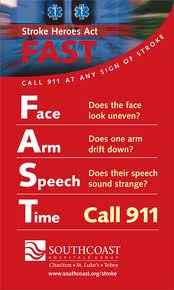
Then Use the F.A.S.T. test to recognize and respond to stroke symptoms:

F = FACE Ask your friend to smile. Does one side of her face droop?

A = ARMS Ask her to raise both arms. Does one arm drift downward?

S = SPEECH Ask her to repeat a simple sentence. Does her speech sound slurred or strange?

T = TIME If you observe any of these signs, don’t delay. Make a note of the time (this will be important later).

Then call 9-1-1 or get to her the nearest stroke center or hospital.

May is Stroke Awareness Month. Learn something new today and share it with friends and family.

Read more about the warning signs of stroke

Do You Know the Special Stroke Symptoms Typical to Women?

[frame_left]Ligtening[/frame_left]Missing the symptoms of stroke will cost you. Time. Brain cells. Maybe your lifestyle, your job, your independence. Maybe even your life.

I know. Stroke happened to me.

Too many women fail to recognize the typical symptoms of stroke (mea culpa, I was one of them): numbness (especially on one side); confusion; trouble speaking, walking, or seeing; sudden severe headache with no apparent cause.

Even fewer understand the 7 special stroke symptoms that most often apply to women:

  • sudden face and limb pain
  • sudden hiccups
  • sudden nausea
  • sudden general weakness
  • sudden chest pain
  • sudden shortness of breath
  • sudden palpitations

It occurs to me some of these might be tough to put together. Hiccups, nausea, general weakness … might be fatigue, or one of those virus bugs that always seem to be going around. Chest pain might be heartburn. Palpitations might be stress.

Or, they might be stroke.

When my stroke hit, I had three of the common the symptoms. I did not recognize them; I never dreamed I might be having a stroke. So why did I call for help? I called because

a still, small voice inside my head kept whispering: Something’s not right.

Excerpt from A Stroke of Bad Luck

Listen to your body. Don’t minimize. Don’t tough it out. Educate yourself and those you love.

Think of the cost. Think of what you–or they–might lose. Then call 9-1-1.

Do you know the symptoms of stroke?

Vitamin D Deficiency May Increase Risk of Clots in APS Patients

When I feel the sniffles coming on, I always reach for some extra vitamin C. And as an autoimmune patient with Antiphospholipid Syndrome (APS) I know to get plenty of rest. But until a few years ago, I’d never thought about Vitamin D. I don’t think my doctors paid much attention to it, either, until research began to show that Vitamin D deficiency is common in the US, and can be especially severe in autoimmune patients.
[frame_left]

[/frame_left]
Once we started checking my Vitamin D levels, we found they were off the chart low. I’d take supplements for a while, but the D would drop back down into the red zone every time I stopped. So the docs and I surrendered and added Vitamin D supplements to my regimen.

A funny thing happened then: I began to feel better. I noticed fewer of those classic autoimmune “flares”–puffy hands, aching joints–days when it hurt just get out of bed; days when I wanted a nap just from the effort of taking a shower. When my D was up, I seemed to have more energy, higher stamina, more enthusiasm. I mentioned this to my docs. No one could think of a reason that Vitamin D should reduce flares but, hey, I took it for the blessing it was.

Now new research is showing is showing at Vitamin D may be more important–especially for Antiphospholipid syndrome patients–than anyone knew.

A new study published in the Annals of the Rheumatic Diseases has found that vitamin D deficiency might be associated with increased coagulation–and attendant risk of blood clots–in APS. The study recommends that APS patients have their Vitamin D levels tested, and, if warranted, take supplements.

Extra protection against stroke and other blood clots from a little green gelcap? I’ll take that any day

Other Resources:

Vitamin D: an instrumental factor in the antiphospholipid syndrome

What Do You Lack? Probably Vitamin D By JANE E. BRODY, New York Times
Published: July 26, 2010

Vitamin D promises to be the most talked-about and written-about supplement of the decade …

If you have APS or another autoimmune disease, be sure to check your vitamin D regularly.


Do You Know The Five Warning Signs of Stroke?

Static crackled as the paramedics talked into a radio.

“We think you are having a stroke,” one said.

Of course I’m not having a stroke, I wanted to tell him. Strokes are for the elderly, for smokers, for overweight couch potatoes.  I’m forty-eight years old, fit and perfectly healthy.

Excerpt from A Stroke of Bad Luck

[frame_left][/frame_left] I was so sure stroke couldn’t happen to me that I didn’t believe the paramedics; I doubted the neurologist in the ER. Yet, I was clearly in the grip of two of the most commons signs of stroke: numbness and lack of control in my right arm, and severe confusion and trouble speaking.



I wasn’t alone. A 2008 study sponsored by the Center for Disease Control found that less than 17% of respondents could identify all five warning signs of stroke and knew to call 9-1-1.

It’s also important to note the time when symptoms started.

How many stroke symptoms can you name?

These are the five most common symptoms of stroke.

  • SUDDEN numbness or weakness of face, arm or leg – especially on one side of the body.
  • SUDDEN confusion, trouble speaking or understanding.
  • SUDDEN trouble seeing in one or both eyes.
  • SUDDEN trouble walking, dizziness, loss of balance or coordination.
  • SUDDEN severe headache with no known cause.

A stroke is an acute medical emergency. Know the 5 Warning Signs – Then Call 9-1-1

May is Stroke Awareness Month. Learn more about stroke and its signs and symptoms

Learning the Facts about Stroke Can Save Your Life

May is always a busy month in my family: three birthdays, Mother’s Day, graduation time and usually some travel. But May is also Stroke Awareness month, something that resonates with me because I was one of those people who thought it couldn’t happen to me. Take the time this May to learn a few things that could save your life or the life of someone you love.

The facts: Stroke is all too common; stroke is shockingly brutal; stroke is not a geriatric disease. It can happen to you or someone you love. I know. It happened to me in 2002, when I was 48 years old. Learn the facts and share them with those you love.

First: Stroke is common

• Each year in the US almost 800,000 people fall victim to stroke, about one every 40 seconds; 150,000 Americans die–one every for minutes.

If you’re a slow reader (as I am since my stroke), by the time you finish this post, four people will have their lives turned over to stroke. One will have died.

Second: Stroke is brutal

• Stroke is the leading cause of serious, long-term disability in the US and the third leading cause of death
• Six million people in the US are living with the after-effects of stroke. Half of them are so disabled they require special care. Seventy percent are unable to return to their former jobs. That seventy percent includes me.

Third: Stroke is not a geriatric affliction

• Each year, Stroke hits more than 200,000 Americans under 65. Almost half of them are under 50. I was one of those.

Fourth: Stroke can be prevented

• Studies show that 80 percent of strokes can be prevented by working with a healthcare professional to reduce personal risk

Coming next: Know the signs of the stroke

Don’t Mess with your Meds: Use “STAR Check” to Prevent Errors

[frame_left][/frame_left]

Sticking to a drug regimen can be confusing for anyone: Doubly so for anyone with impaired memory or attention deficits. Most stroke patients fall into that category. I know I do.

I left the hospital after my stroke still dazed, groping through each day behind a veil of confusion. Within a few weeks, doctors found that my stroke had been caused by a serious autoimmune clotting disorder, Antiphospholipid Syndrome (APS). Because the danger of repeat strokes is so high with APS, I was “sentenced” to take Coumadin (the generic name is warfarin) for the rest of my life. The Coumadin would make my blood less prone to clots. But too much Coumadin could result in a dangerous bleeding accident. Continue reading “Don’t Mess with your Meds: Use “STAR Check” to Prevent Errors”

12 Safety Tips for Managing Your Meds

Healthy hard bodies whose ills amount to the occasional cold or case of shin splints from overdoing the marathon circuit don’t need advice on managing medications. For rest of us these common sense tips on drug safety can apply to everyone, but are but are crucial for stroke and autoimmune patients, anyone with impaired memory, or chronic illnesses that involve multiple meds.

1. Take a notebook to the doctor’s office and write down all instructions–preferably the same notebook each time. (Have a little fun–choose a notebook with cartoon characters or my personal favorite, the skull and crossbones in vivid pink by Peter Pauper Press.)

2. Know what you’re taking. Ask the doctor:

  • the name of the medication
  • what it’s for
  • how to take it (how often? what times? with food or without?)
  • how long to take it
  • what side effects to expect
  • whether there may be interactions with any other medications

Pay attention to the answers and write them down.

3. Make sure every doctor knows every drug you take, including any over-the-counter remedies. (No cheating ‘cause you don’t want the doc to know about those shyster weight-loss pills you ordered from late night TV!)

4. Watch out for drug interactions! Each time you receive a new prescription, ask the doctor about possible interactions with any other medications you’re taking, whether prescription or over-the-counter.

5. Find a pharmacy that’s convenient and seems to have a good safety culture (It’s hard, I know, with mass-market chains invading our neighborhoods like alien mother ships. Just do the best you can.)

6. Make sure you can open the bottle. If you have trouble opening child safety caps (like many stroke or arthritis patients, including me), ask for easy-open caps; but be sure to store to store them out of the reach of children.

7. Resist the urge to grab ‘n go. For every new prescription, take a minute to go over the instructions with the pharmacist before you leave the store. If you buy any new over-the-counter products, ask the pharmacist about interactions with your prescriptions.

8. Mail order? If you order prescriptions through the mail, make sure the service allows you to speak to  a pharmacist by phone if you have questions.

9. With every refill, check before you leave the store. Make sure it’s the right drug, the right brand, the correct dose, and in a bottle you can manage.

10. Have a set routine for taking your medicines.  I take my most important ones at bedtime after I brush my teeth. At pill-taking time, pause, clear your mind and pay attention to what you’re doing. (See related post STAR Check for Drug Safety.)

11. Store your medications properly. Read the package insert for instructions. Most medications do well in a cool and dry place, away from heat and light, and well out of reach of children. (Note: the warm, humidity of the bathroom is usually not the best place!) Some prescriptions require refrigeration. Don’t mix different medications in the same container.

12. Watch the expiration date. The dates are conservative and there’s almost always a little wiggle-room. But if you store your meds in the warm humidity of a bathroom they may degrade more quickly.  Discard medications that have become discolored or powdery or small strong.

Other Resources:

The Five Most Dangerous Medicine Mistakes that Way Too Many People Make

Please share your own tips for safe management of meds.