A research team at the University of California, San Francisco (UCSF), has identified a genetic mutation that is strongly associated with a typical form of migraine headache—migraine with aura. The research “puts us one step closer to understanding the molecular pathway to pain in migraine,” according to Louis J. Ptáček, senior investigator on the study and a professor of neurology at UCSF. “And, as we come to a clearer understanding, we can start thinking about better therapies,” he said.
The mutation is in the gene known as casein kinase I delta (CKIdelta). You can read more about the research here.
Could that mean that, one day, genetic testing can help identify people who are at increased for stroke? I hope so. I was one of them
I suffered from relatively mild migraines for twenty years before I had a stroke. Though mild, my migraines were the type of migraine the UCSF study describes: with “aura,” that strange visual disturbance that always preceded the headache—blind spots, zigzag lines or flashing dots that seemed to pulse before my eyes. Once I saw the aura, the rest would be only minutes behind—the pounding headache, over-sensitivity to light and sound, sometimes nausea. I knew women who had migraines so severe they had to stay home from work and retreat to a dark room in agony. Fortunately mine weren’t that bad.
But—though I didn’t know it at the time—even these mild migraines put me at significantly increased risk for stroke.
Women who suffer from migraines with aura (visual disturbances such as flashing dots or blind spots) can be up to ten times more likely to suffer a stroke, depending on other risk factors, according to Dr. Steven J. Kittner, professor of neurology and director of the Maryland Stroke Center, University of Maryland School of Medicine.
Migraine is also one of the symptoms of the clotting disorder that caused my stroke, an autoimmune disease I never knew I had until I was slammed by a stroke at forty-eight years old. It’s called Antiphospholipid Syndrome or APS. APS is also sometimes called “sticky” blood because it makes the blood “thicker” and more prone to clots. After my stroke more than ten years ago, I was put on blood thinners for life. I haven’t had a migraine since. It almost seems to me like the headache signaled my sludgy blood struggling flow through my brain. Until it got stuck and formed a clot that caused a stroke that reordered my life.
I want to get the word out about migraine. If you have them, you’re at increased risk for stroke. Do your brain a favor: evaluate any other risks for stroke you have, and try to reduce them.
Risk factors are cumulative,” Dr. Kittner adds. “Reducing even one risk can greatly lower your chances of having a stroke.”
I never thought much about my brain until it went haywire on me.
I’d ignored a few months of irksome forgetfulness–just approaching menopause, I thought; nothing serious. And, with perfect blood pressure, low cholesterol, regular exercise, and a healthy weight, I had no idea I could be at risk for stroke.
I was home alone the morning my stroke hit. The only symptom I noticed at first was a “floppy doll” hand.
“Strange, I thought,” my hand fell asleep in the shower.”
Of course, hands don’t really fall asleep in the shower—a symptom that my thinking was confused. Other than being unable to control my hand, I felt fine, except for a strange out-of-body sensation, almost like I was a hovering witness looking down on myself. There was this nagging thought that I should call for help, but I felt almost guilty at the thought of rousting someone to come over. After all, I wasn’t in any pain.
Gradually it dawned on me that I couldn’t remember where to find my husband, couldn’t think of a single friend’s name, didn’t know how to work the computer, and finally—when I decided to call emergency, anyway—I couldn’t remember the number: 911.
I did think to dial “O.” It was only when the operator answered and I tried to speak that I realized: the “words” coming from my mouth were just gibberish. The operator had to trace the call to send an ambulance.
When the paramedic told me I was having a stroke, I didn’t believe him. Of course I’m not having a stroke, I wanted to tell him. Strokes are for the elderly, for smokers, for overweight couch potatoes. I’m forty-eight years old, fit and perfectly healthy.Perfectly healthy people don’t just wake up feeling fine and then–out of the blue–have strokes.”
But sometimes they do. I did.
Save a brain, of even a life. Make sure you and your loved ones know the most common warning signs for stroke:
SUDDEN numbness or weakness of face, arm or leg – especially on one side of the body.
SUDDEN confusion, trouble speaking or understanding.
SUDDEN trouble seeing in one or both eyes.
SUDDEN trouble walking, dizziness, loss of balance or coordination.
SUDDEN severe headache with no known cause.
Stroke symptoms may be different in women. Symptoms typical in women also include:
SUDDEN face and limb pain
SUDDEN hiccups
SUDDEN nausea
SUDDEN general weakness
SUDDEN chest pain
SUDDEN shortness of breath
SUDDEN palpitations
A stroke is an acute medical emergency. Know the warning signs —then Call 9-1-1
Has anyone in your experienced stroke? What were the symptoms?
The proliferation of medical information on the web makes it easier than ever for patients to be informed about their health. It’s also easy to be misinformed and confused by page after page of Google results that are often confusing and contradictory.
1. Health On the Net Foundation HON: Tina Polhman, president of the APS Foundation of America, reminded me of HON, a well-regarded NGO (non-government organization) that introduced a code of conduct for medical and health web sites (HONcode) that has been adopted by some 3,000 websites worldwide. HON also operates a website, @HON with a search engine that searches only HON certified sites. 2. WebMD: My own doctor suggested I add this to the list. WebMD has a wealth of information on conditions, symptoms, causes, and treatments. It also offers a drug checker and sections on healthy living and family health.
Stroke, autoimmune disease, and brain injury are my own primary areas of interest and I offer a list on information sources on the resources pages of AnneSigmon.com.
Patients already taking the blood thinner Coumadin (warfarin), even at low doses, may not be good candidates for the clot-busting drug tPA in the event of a stroke, a new study indicates.
Thrombolysis (treatment with the “clot-busting” drug tPA) in the early stages of a new stroke is often the very best hope a patient has to recover with minimal brain damage. It’s been called a ‘miracle drug,’ because many patients recover with minimal or no loss of function. But tPA comes with a risk: the potential for bleeding inside the brain, which can often be more catastrophic than the stroke.
For that reason, there are strict protocols indicating when tPA should be considered. It must be given within three hours of the onset of symptoms and should not be given to patients for whom the risk of bleeding outweighs the benefits. It’s a long list: patients who’ve had seizures, head trauma, major surgery, who’ve been given the blood thinner heparin. Patients taking Coumadin (warfarin) have also been excluded if their INR (a measure of how “thin” their blood is compared to a “normal”) is significantly higher than normal.
A “normal” INR is about 1.0. The “therapeutic range” to help prevent blood clots is usually between 2.0 and 3.0. Patients taking warfarin at below-therapeutic levels (with an INR below about 1.7) have been considered eligible for thrombolysis.
The current study, conducted by the Medical University Innsbruck, Innsbruck, Austria, found that patients taking warfarin at subtherapeutic levels had a significantly higher rate of symptomatic intracranial hemorrhage than other patients.
The study was small, but it included a “meta analysis” of nine past studies. Four of them found a significantly increased bleeding risk among patients with elevated but “subtherapeutic” INR. Five found no increased risk.
So the jury is still out. An editorial in the Journal Neurology summed up our current state of knowledge: “But as the overall findings support the possibility of an increased bleeding risk in patients with warfarin … “clearly, the decision for [intravenous] thrombolysis needs to be taken with caution in these patients.”
For those of us who take Coumadin, it sometimes seems like we’re tip-toeing everyday through a minefield of potentially fatal risks and decisions. Some days I want to stick my head in the sand, ignore the risks and just live my life. Not smart. The risks are real, and the day may come when we or our families have to face hard decisions like this. That’s why we need to stay informed. Thanks to Tina Pohlman for sharing this item on the APSFA Facebook site.
May is stroke awareness month. It’s a time to raise our awareness of the horrendous consequences of stroke and what we can do to reduce them.
Most days, I don’t like to think about stroke and what it cost me. I’d rather get on with my life and focus on what I can still do–be a wife, daughter, sister, grandmother, friend. Speak. Read. Write. Drive. Travel to still-wild places.
Ten years on, I still fight the deficits from my stroke every day–a flighty disorganization, memory like a sieve, a discoordinated hand with almost no feeling–but I lead a full and interesting life. Most people say they have no idea I’ve had a stroke. I hide it well.
Most stroke survivors aren’t nearly so lucky.
The Cost
It’s easy to get lost in statistics:
Almost 800,000 strokes each year in the US and nearly 140,000 deaths
Stroke is the No. 4 cause of death in the US, behind heart disease (with which it is closely linked) cancer, and respiratory disease .
Stroke is one of the top causes of disability among adults in the US.
More than five million Americans are living with the effects of stroke.
But what does this really mean?
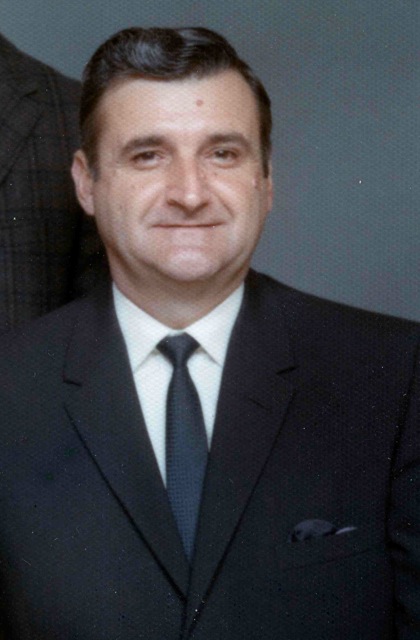
My Uncle O.W.
More than twenty-five percent of stroke victims die within a year of their first stroke. Fifteen percent die within a few days or weeks. That was O.W., my uncle (by marriage), a husband, father, and brilliant mathematician. He died within a week of suffering a devastating hemorrhagic stroke. Multiply his story by 187,000.
Ten percent of stroke victims require care in a nursing home or other long-term care facility. There are 80,000 of those each year.
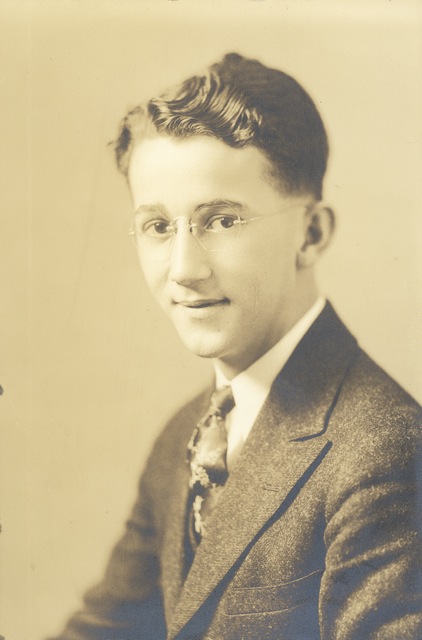
Jack's Uncle Jim
Forty percent of stroke victims are so impaired that they require special care. That was another uncle, of my husband’s. Jim, an avid reader, was blinded by his stroke. His wife went from new bride to caregiver in a short time. That’s also my friend, Gerry, a high tech marketing and product manager until his stroke forced his retirement. Now, he stays home, unable to drive, while his wife works. Multiply their stories by 300,000 each year.
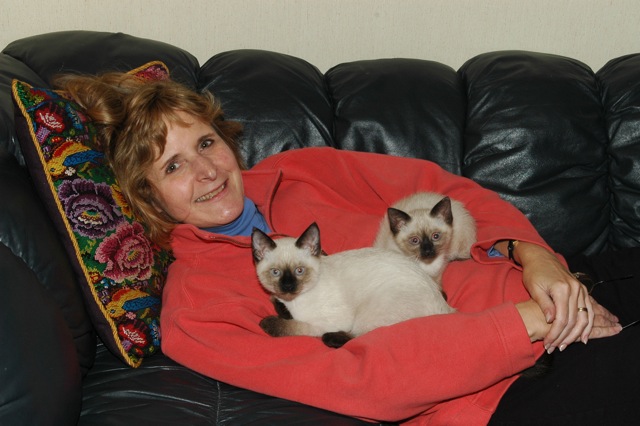
Me, resting with my kittens
Twenty-five percent of stroke victims recover with minor impairments. That’s me. Lucky with only “minor” deficits, but I am still one of the seventy percent unable to return to their previous jobs. I can’t figure out the tip on a restaurant bill or sew on a button. Multiply my story about 187,000 every year.
A still luckier lucky ten percent of stroke victims recover almost completely after their strokes. I haven’t met any of those yet, but there are 80,000 each year.
A single year’s stroke victims could populate a city the size of San Francisco. But wait: it would need a much larger population to accommodate all the caregivers.
A city of stroke survivors–five million of us–would be the second largest city in the US, behind only New York.
It’s a jungle out there and I just can’t get enough of it!
Come help me celebrate publication of my story “Why I Still Travel to the Wild” at a book party sponsored by Left Coast Writers. It’s on Monday evening, November 14, at 6 pm at Book Passage San Francisco store at the SF Ferry Building. (Just one block from Embarcadero BART.)
My story is a reflection on my (some might say stubborn) determination to continue traveling to remote corners even after my health was compromised by a stroke and autoimmune disease. It’s just out in the new anthology Chicken Soup for the Soul: Find Your Happiness.
Join us for wine, hors d’oeuvres and jungle-y treats plus, reading and a drawing for prizes. Fellow author Nicole Guiltinan will join me. It’s free and open to the public. Great opportunity to start your holiday shopping!
Address: Book Passage, 1 Ferry Building, San Francisco, CA 94111 Book Store phone: (415) 835-1020
You’ve met for coffee and a catch-up, one of those girlfriend gabfests about jobs-kids-guys-great books-bad movies-vacation plans. You’re distracted trying decide between the relative evils of sweet’N low vs. sugar. Suddenly you notice that your friend’s story about her weekend from hell in Las Vegas isn’t making much sense. Her speech seems slurred, she’s stumbling over words, seems confused and–you can’t quite put your finger on it– but there’s something odd about the way she looks.
Maybe she’s just tired, you think. Or maybe not. What should you do?
You should remember that slurred speech and confusion could be signs of a stroke.
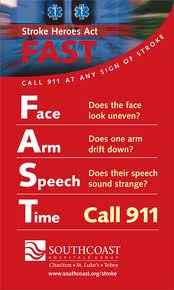
Then Use the F.A.S.T. test to recognize and respond to stroke symptoms:
F = FACE Ask your friend to smile. Does one side of her face droop?
A = ARMS Ask her to raise both arms. Does one arm drift downward?
S = SPEECH Ask her to repeat a simple sentence. Does her speech sound slurred or strange?
T = TIME If you observe any of these signs, don’t delay. Make a note of the time (this will be important later).
Then call 9-1-1 or get to her the nearest stroke center or hospital.
May is Stroke Awareness Month. Learn something new today and share it with friends and family.
[frame_left][/frame_left]Missing the symptoms of stroke will cost you. Time. Brain cells. Maybe your lifestyle, your job, your independence. Maybe even your life.
I know. Stroke happened to me.
Too many women fail to recognize the typical symptoms of stroke (mea culpa, I was one of them): numbness (especially on one side); confusion; trouble speaking, walking, or seeing; sudden severe headache with no apparent cause.
Even fewer understand the 7 special stroke symptoms that most often apply to women:
sudden face and limb pain
sudden hiccups
sudden nausea
sudden general weakness
sudden chest pain
sudden shortness of breath
sudden palpitations
It occurs to me some of these might be tough to put together. Hiccups, nausea, general weakness … might be fatigue, or one of those virus bugs that always seem to be going around. Chest pain might be heartburn. Palpitations might be stress.
Or, they might be stroke.
When my stroke hit, I had three of the common the symptoms. I did not recognize them; I never dreamed I might be having a stroke. So why did I call for help? I called because
a still, small voice inside my head kept whispering: Something’s not right.
Excerpt from A Stroke of Bad Luck
Listen to your body. Don’t minimize. Don’t tough it out. Educate yourself and those you love.
Think of the cost. Think of what you–or they–might lose. Then call 9-1-1.
Static crackled as the paramedics talked into a radio.
“We think you are having a stroke,” one said.
Of course I’m not having a stroke, I wanted to tell him. Strokes are for the elderly, for smokers, for overweight couch potatoes. I’m forty-eight years old, fit and perfectly healthy.
Excerpt from A Stroke of Bad Luck
[frame_left][/frame_left] I was so sure stroke couldn’t happen to me that I didn’t believe the paramedics; I doubted the neurologist in the ER. Yet, I was clearly in the grip of two of the most commons signs of stroke: numbness and lack of control in my right arm, and severe confusion and trouble speaking.
I wasn’t alone. A 2008 study sponsored by the Center for Disease Control found that less than 17% of respondents could identify all five warning signs of stroke and knew to call 9-1-1.
It’s also important to note the time when symptoms started.
How many stroke symptoms can you name?
These are the five most common symptoms of stroke.
SUDDEN numbness or weakness of face, arm or leg – especially on one side of the body.
SUDDEN confusion, trouble speaking or understanding.
SUDDEN trouble seeing in one or both eyes.
SUDDEN trouble walking, dizziness, loss of balance or coordination.
SUDDEN severe headache with no known cause.
A stroke is an acute medical emergency. Know the 5 Warning Signs – Then Call 9-1-1

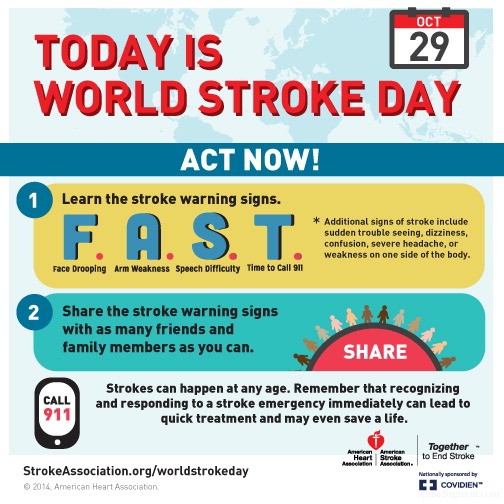
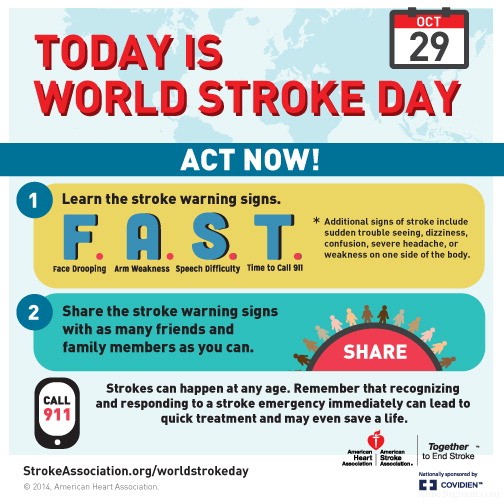 Mark World Stroke Day by learning the warning signs of stroke. Remember F.A.S.T
 m at the University of California, San Francisco (UCSF), has identified a genetic mutation that is strongly associated with a typical form of migraine headache—migraine with aura. The research “puts us one step closer to understanding the molecular pathway to pain in migraine,” according to Louis J. Ptáček, senior investigator on the study and a professor of neurology at UCSF. “And, as we come to a clearer understanding, we can start thinking about better therapies,” he said.
 I never thought much about my brain until it went haywire on me.









 [/frame_left] I was so sure stroke couldn’t happen to me that I didn’t believe the paramedics; I doubted the neurologist in the ER. Yet, I was clearly in the grip of two of the most commons signs of stroke: numbness and lack of control in my right arm, and severe confusion and trouble speaking.