
Heed the warning of stroke-like symptoms and see your doctor ASAP

Torres del Paine jbm - 143In the year or two before my stroke, I was aggravated by mild but annoying memory and cognition problems: forgetting movies I’d just seen or books I’d recently read. Then there were the strange typos when I wrote at my computer.


‘Height’ was written as ‘right.’ ‘Core’ was written as ‘bore’—rhyming mistakes that didn’t come from a missed finger on the keyboard. I never make typos like that, I thought.

Excerpt from Scrambling Back:One Woman’s Quest to Return to te Wild After Stroke and Autoimmune Disease


This oddity—I didn’t think of it at a “symptom”—seemed too vague to take to a doctor. It was probably just menopause coming on, I decided. Besides, I was busy and otherwise felt fine. Later, after my stroke, my speech therapist explained that my “oddity” was indeed a neurological symptom that my brain might not be getting enough oxygen.

Unusual forgetfulness and the kind of rhyming mistakes I was making are “stroke-like” symptoms. They can—as in my case—be a sign of a stroke to come. They can also signal a brain that is beginning to develop memory and cognition problems that could lead to dementia, according to research published in the journal Neurology.

 The study found that people who had stroke symptoms were more likely to develop memory and thinking problems: Twice as likely among Caucasians and three likes as likely among African Americans.

“Our study highlights the importance of discussing stroke-like symptoms with your family doctor, even if they don’t last long. These symptoms can be a warning sign that a person is at increased risk of stroke or problems with thinking or memory,” said study author Dr. Brendan J. Kelley of the University of Cincinnati.

Find more information about the study here.

When I think back to those quirky symptoms I had in the year before my stroke, I realize:  If I’d reported these to my doctor—my gynecologist, the only doctor I had back then—if she had connected the dots … She might have ordered tests that would have pinpointed three alarming risks for stroke: migraines, a genetic risk for stroke called Factor V Leiden, and, most serious, an autoimmune clotting disorder that was turning my blood to sludge. Surely she would have ordered me to stop taking estrogen in the form of birth control pills. She might have prescribed an aspirin a day to reduce my stroke risk. My stroke might have been prevented.

If. If. If. That’s a place I don’t like to go.

But it’s not too late for you. Learn about stroke risks and how they might apply to you. And if you experience symptoms, even quirky ones, see your doctor ASAP.

Read more about the risk factors for stroke here.
 

World Stroke Day

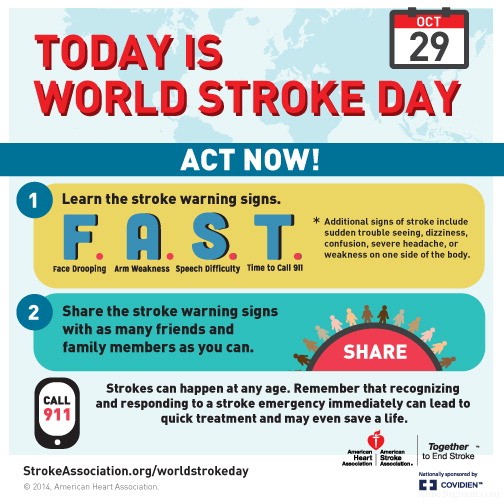
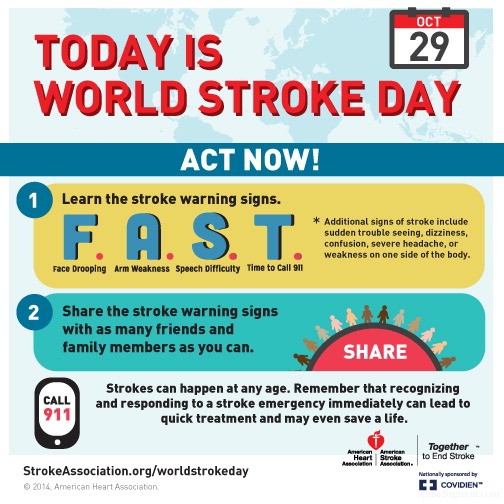
World Stroke Dday attach to FB Mark World Stroke Day by learning the warning signs of stroke. Remember F.A.S.T

  • Face drooping
  • Arm weakness
  • Speech difficulty
  • Time to get help: Call 9-1-1

Now, share what you’ve learned with someone you love. You’ll feel good; and you may even save a life.

I learned about the warning signs for stroke the hard way. Read more about my experience here. http://bit.ly/13g0hBC


Stroke: Know the Warning Signs Unique to Women

I never thought much about my brain until it went haywire on me.

I’d ignored a few months of irksome forgetfulness–just approaching menopause, I thought; nothing serious. And, with perfect blood pressure, low cholesterol, regular exercise, and a healthy weight, I had no idea I could be at risk for stroke.

I was home alone the morning my stroke hit. The only symptom I noticed at first was a “floppy doll” hand.

“Strange, I thought,” my hand fell asleep in the shower.”

Of course, hands don’t really fall asleep in the shower—a symptom that my thinking was confused.  Other than being unable to control my hand, I felt fine, except for a strange out-of-body sensation, almost like I was a hovering witness looking down on myself. There was this nagging thought that I should call for help, but I felt almost guilty at the thought of rousting someone to come over. After all, I wasn’t in any pain.

Gradually it dawned on me that I couldn’t remember where to find my husband, couldn’t think of a single friend’s name, didn’t know how to work the computer, and finally—when I decided to call emergency, anyway—I couldn’t remember the number­: 911.

I did think to dial “O.” It was only when the operator answered and I tried to speak that I realized: the “words” coming from my mouth were just gibberish. The operator had to trace the call to send an ambulance.

When the paramedic told me I was having a stroke, I didn’t believe him. Of course I’m not having a stroke, I wanted to tell him. Strokes are for the elderly, for smokers, for overweight couch potatoes.  I’m forty-eight years old, fit and perfectly healthy. Perfectly healthy people don’t just wake up feeling fine and then–out of the blue–have strokes.”

But sometimes they do. I did.

Save a brain, of even a life. Make sure you and your loved ones know the most common warning signs for stroke:

  • SUDDEN numbness or weakness of face, arm or leg – especially on one side of the body.
  • SUDDEN confusion, trouble speaking or understanding.
  • SUDDEN trouble seeing in one or both eyes.
  • SUDDEN trouble walking, dizziness, loss of balance or coordination.
  • SUDDEN severe headache with no known cause.


Stroke symptoms may be different in women.  Symptoms typical in women also include:

  • SUDDEN face and limb pain
  • SUDDEN hiccups
  • SUDDEN nausea
  • SUDDEN general weakness
  • SUDDEN chest pain
  • SUDDEN shortness of breath
  • SUDDEN palpitations

A stroke is an acute medical emergency. Know the warning signs —then Call 9-1-1

Has anyone in your experienced stroke? What were the symptoms?

What Should You Do If You Think Someone May Be Having a Stroke?

You’ve met for coffee and a catch-up, one of those girlfriend gabfests about jobs-kids-guys-great books-bad movies-vacation plans. You’re distracted trying decide between the relative evils of  sweet’N low vs. sugar. Suddenly you notice that your friend’s story about her weekend from hell in Las Vegas isn’t making much sense. Her speech seems slurred, she’s stumbling over words, seems confused and­–you can’t quite put your finger on it– but there’s something odd about the way she looks.

Maybe she’s just tired, you think. Or maybe not. What should you do?

You should remember that slurred speech and confusion could be signs of a stroke.

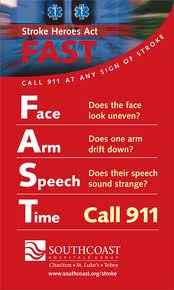
Then Use the F.A.S.T. test to recognize and respond to stroke symptoms:

F = FACE Ask your friend to smile. Does one side of her face droop?

A = ARMS Ask her to raise both arms. Does one arm drift downward?

S = SPEECH Ask her to repeat a simple sentence. Does her speech sound slurred or strange?

T = TIME If you observe any of these signs, don’t delay. Make a note of the time (this will be important later).

Then call 9-1-1 or get to her the nearest stroke center or hospital.

May is Stroke Awareness Month. Learn something new today and share it with friends and family.

Read more about the warning signs of stroke

Do You Know the Special Stroke Symptoms Typical to Women?

[frame_left]Ligtening[/frame_left]Missing the symptoms of stroke will cost you. Time. Brain cells. Maybe your lifestyle, your job, your independence. Maybe even your life.

I know. Stroke happened to me.

Too many women fail to recognize the typical symptoms of stroke (mea culpa, I was one of them): numbness (especially on one side); confusion; trouble speaking, walking, or seeing; sudden severe headache with no apparent cause.

Even fewer understand the 7 special stroke symptoms that most often apply to women:

  • sudden face and limb pain
  • sudden hiccups
  • sudden nausea
  • sudden general weakness
  • sudden chest pain
  • sudden shortness of breath
  • sudden palpitations

It occurs to me some of these might be tough to put together. Hiccups, nausea, general weakness … might be fatigue, or one of those virus bugs that always seem to be going around. Chest pain might be heartburn. Palpitations might be stress.

Or, they might be stroke.

When my stroke hit, I had three of the common the symptoms. I did not recognize them; I never dreamed I might be having a stroke. So why did I call for help? I called because

a still, small voice inside my head kept whispering: Something’s not right.

Excerpt from A Stroke of Bad Luck

Listen to your body. Don’t minimize. Don’t tough it out. Educate yourself and those you love.

Think of the cost. Think of what you–or they–might lose. Then call 9-1-1.

Do you know the symptoms of stroke?

Do You Know The Five Warning Signs of Stroke?

Static crackled as the paramedics talked into a radio.

“We think you are having a stroke,” one said.

Of course I’m not having a stroke, I wanted to tell him. Strokes are for the elderly, for smokers, for overweight couch potatoes.  I’m forty-eight years old, fit and perfectly healthy.

Excerpt from A Stroke of Bad Luck

[frame_left][/frame_left] I was so sure stroke couldn’t happen to me that I didn’t believe the paramedics; I doubted the neurologist in the ER. Yet, I was clearly in the grip of two of the most commons signs of stroke: numbness and lack of control in my right arm, and severe confusion and trouble speaking.

I wasn’t alone. A 2008 study sponsored by the Center for Disease Control found that less than 17% of respondents could identify all five warning signs of stroke and knew to call 9-1-1.

It’s also important to note the time when symptoms started.

How many stroke symptoms can you name?

These are the five most common symptoms of stroke.

  • SUDDEN numbness or weakness of face, arm or leg – especially on one side of the body.
  • SUDDEN confusion, trouble speaking or understanding.
  • SUDDEN trouble seeing in one or both eyes.
  • SUDDEN trouble walking, dizziness, loss of balance or coordination.
  • SUDDEN severe headache with no known cause.

A stroke is an acute medical emergency. Know the 5 Warning Signs – Then Call 9-1-1

May is Stroke Awareness Month. Learn more about stroke and its signs and symptoms