New Yorker essay shines a spotlight on the scourge of autoimmune disease

For autoimmune patients—and I’m one of them—life sometimes feels like a lonely uphill climb:
“getting sick for no good reason, falling prey to esoteric infections and mysterious skin outbreaks, sliding into spells of lethargy and exhaustion that looked so much like laziness it was maddening.”
Excerpt from A Stroke of Bad Luck and the Potholed Road to Recovery
In her essay “What’s Wrong With Me” published in this week’s New Yorker (Aug. 26, 2013), author Meghan O’Rourke shines a spotlight on what it’s like to live with autoimmune disease. Recounting experiences all too familiar to autoimmune patients, and to me, O’Rourke describes:
- symptoms ranging from hives to migraines, buzzing in her throat, numbness in her feet;
- terrible fatigue that made her feel like “a mechanism that moved arduously through the world, simply trying to complete its tasks. Sitting upright at my father’s birthday party required a huge act of will.”
- her brain often “enveloped in a thick gray fog”
- a susceptibility to viruses (in her case cytomegalovirus, parvovirus, and Epstein-Barr)
- a family history sprinkled with various seemingly unrelated illnesses that (she learned later) are all autoimmune in nature.
Like many autoimmune patients, O’Rourke rattled from doctor to doctor for years before any of them believed she had a disease. “Many clinicians assume that the patient, who is often a young woman, is just one of the ‘worried well,’” she writes. Finally, after six years, she had her diagnosis: autoimmune thyroiditis, often called Hashimoto’s, the same disease that plagued my grandmother.
I missed the the doctor-to-doctor crawl because I had no clue that my body was harboring any kind of illness until I was felled by a stroke caused by my particular autoimmune disease: antiphospholipid syndrome (APS).
O’Rourke writes movingly about what it’s like to struggle with a debilitating condition—autoimmunity—that no one, even specialists, understands well.
The lack of knowledge is shocking to me, considering the magnitude of the problem: The American Association of Autoimmune Related Diseases (AARDA) estimates that as many as fifty million Americans suffer from autoimmunity—a greater number than cancer.
There are somewhere between eighty and one hundred autoimmune diseases, yet “autoimmune disease is as much of a medical frontier today as syphilis or tuberculosis was in the nineteenth century,” O’Rourke writes. “Some researchers say the number of cases is rising at almost epidemic rates.”
At times during the course of searching for a diagnosis and treatment of her illness O’Rourke questioned her own sanity:
- “Was I going mad?” she asks.
- “The worst part of my fatigue, the one I couldn’t explain to anyone—I knew I’d seem crazy—was the loss of an intact sense of self.”
- “To be sick in this way is to have the unpleasant feeling that you are impersonating yourself.”
“It was a struggle,” she writes, “to do anything—to teach my class, to tidy the house, to go to the gym. My joints hurt, my neck hurt; I had nosebleeds and large bruises up and down my legs. I spend hours everyday unable to work …” This situation is all too familiar to me and other autoimmune patients.
Like many who suffer from autoimmunity, O’Rourke found information and solace in on-line support groups, “people, rich and poor, who were connected by one thing: the inability of doctors to alleviate their symptoms.” She also turned to diet hoping to mediate her disease. She followed a diet similar to the so-called Paleo regimen: “no gluten, no refined sugar, little dairy” so strictly that, while it did ease some of her symptoms, she spent “at least half of each day” shopping for food, eating, and cleaning up.
“What I had wasn’t just an illness now; it was an identity, a membership in a peculiarly demanding sect. I had joined the First Assembly of the Diffusely Unwell …”
But O’Rourke realized that she didn’t want her life to be defined by illness.
Echoing the concern of many autoimmune patients, she writes: “I worried that I would no longer have friends.”
“The chronically ill patient has to hold in mind two contradictory modes: insistence on the reality of her disease, and resistance to her own catastrophic fears.” Amen to that.
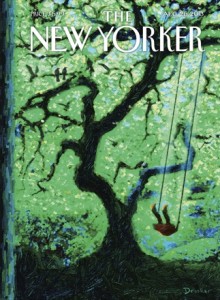 O’Rourke’s thoughtful essay has much more to say about autoimmune disease and her experience. Anyone concerned about the scourge of autoimmunity should read it. If you’re not a New Yorker subscriber, you can find this issue at newsstands this week, or order a single copy from The New Yorker here.